
The Unit Economics of the 'Clean Girl' Aesthetic: How Indie Brands Scale via TikTok Shop
Jessie Kim · Published May 24, 2026 · 4 min read
We all feel the shift. For years, the "Clean Girl" aesthetic has dominated our feeds—dewy skin, slicked-back hair, and minimalist makeup that promises effortless perfection. But beneath that effortless facade lies a highly calculated, hyper-aggressive business engine.
As an MBA grad and curiously-led industry insights researcher, looking at the landscape of Southern California’s beauty ecosystem, I’ve realized that the real story isn't the aesthetic itself. It’s how independent beauty brands are using this specific minimalist look to fundamentally rewrite the rules of direct-to-consumer (DTC) unit economics. And they are doing it by turning TikTok Shop into their primary scaling engine.
Let’s pull back the curtain on the actual business metrics driving the clean beauty boom.
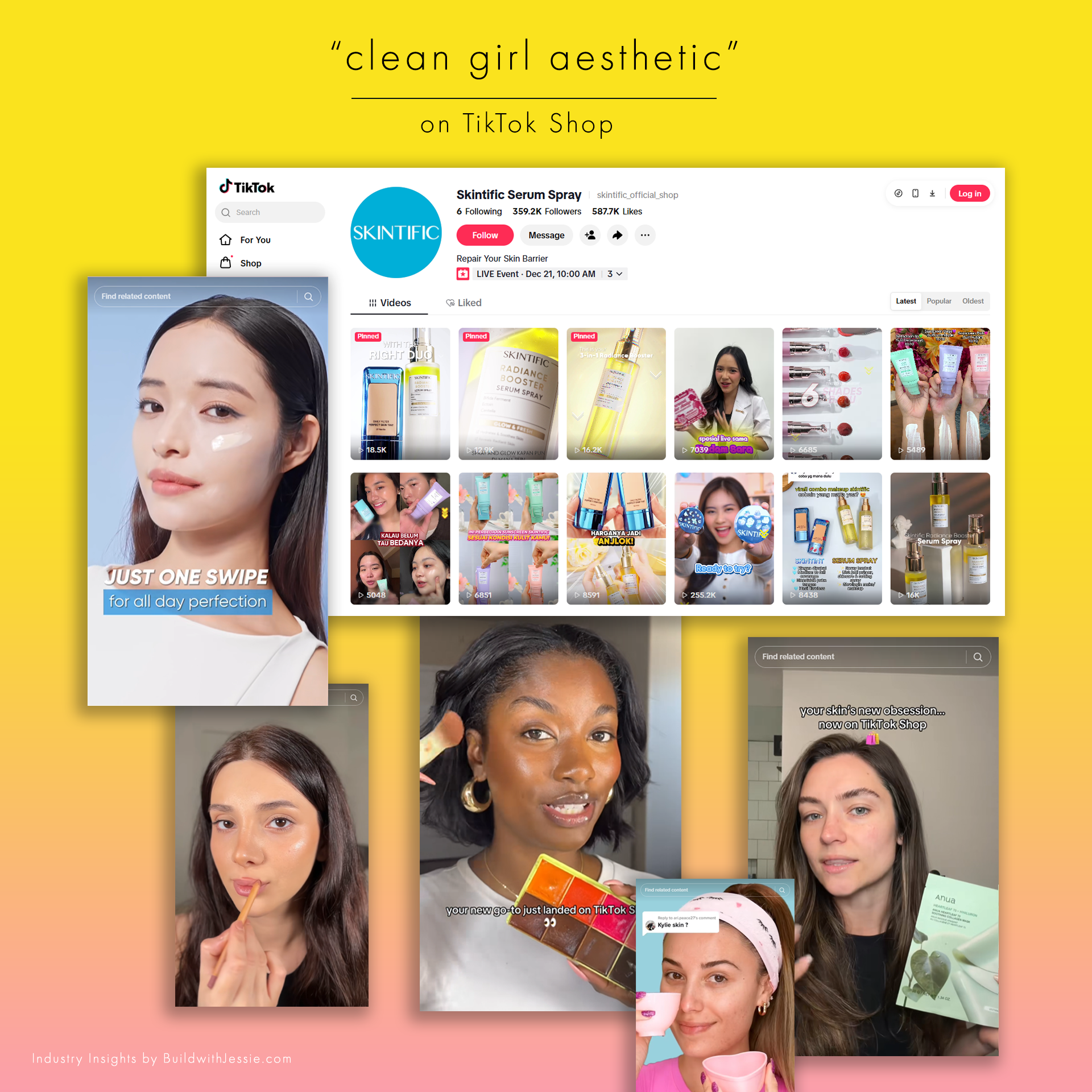
The Aesthetic Arbitrage: Why Minimalism is Cheap to Make
Before we even look at social commerce, we have to look at the product margin. The "Clean Girl" aesthetic relies heavily on minimalist, multi-functional products: tinted face oils, cream blushes, and clear lip glosses.
From a product development perspective, this is pure financial leverage.
Lower COGS (Cost of Goods Sold): Formulating a high-coverage, 40-shade matte foundation is incredibly expensive. It requires complex pigment stabilization and massive initial inventory overhead. A sheer skin tint or a multi-use dewy balm, however, requires fewer raw materials, simpler emulsification, and a tighter, more forgiving shade range.
The Sourcing Leverage: For independent brands based out of Southern California, the proximity to turnkey private-label labs means they can prototype, manufacture, and bottle a minimalist cream blush at a fraction of the cost—and at twice the speed—of traditional color cosmetics.
When your Cost of Goods Sold drops, your gross margins skyrocket. Indie brands in this space frequently operate at 75% to 80% gross margins before marketing spend.
Flipping the Funnel: TikTok Shop as the Ultimate Margin Protector
Historically, the death sentence for indie DTC beauty brands has been Customer Acquisition Cost (CAC). In the traditional Shopify-plus-Meta-ads playbook, brands bleed cash trying to force a consumer to click an ad, leave a social app, load a website, add to a cart, and check out. Every step in that funnel is a drop-off point where $CAC$ ticks upward.
TikTok Shop has completely flipped this dynamic by introducing Discovery Commerce with in-app checkout. According to recent commerce data, TikTok Shop processed over $15 billion in US sales in 2025 alone, with health and beauty consistently dominating the platform's revenue share (Branvas, 2026; AutoFaceless.ai, 2026).
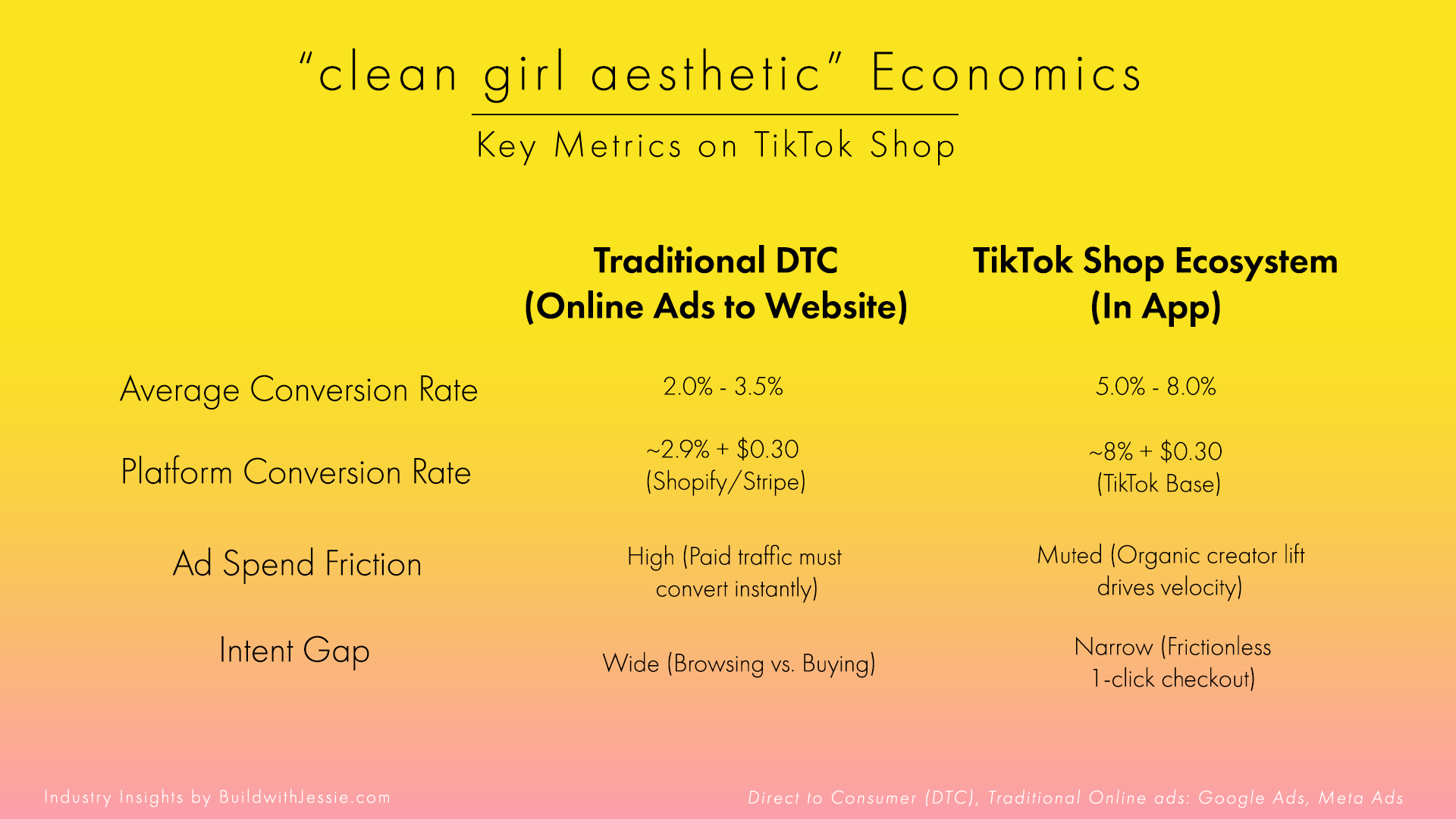
By squeezing the conversion rate up to 5–8% through native in-app checkout, the algorithm drastically lowers the baseline marketing cost required to acquire a single customer (AutoFaceless.ai, 2026).
The Affiliate Army: Variable vs. Fixed Marketing Costs
The true genius of how indie clean beauty scales on TikTok Shop lies in the Affiliate Marketplace. Traditional influencer marketing requires upfront, fixed talent fees. An indie brand might pay a creator $2,000 for a dedicated video and pray that it converts. If it bombs, the brand absorbs a 100% loss on that marketing capital.
On TikTok Shop, brands leverage Targeted and Open Collaborations using a purely variable cost model.
I see brands building networks of hundreds of micro- and nano-creators who receive a free product sample (a minimal upfront cost) and agree to a 10% to 15% commission on the backend sales they generate (Darkroom, 2026).
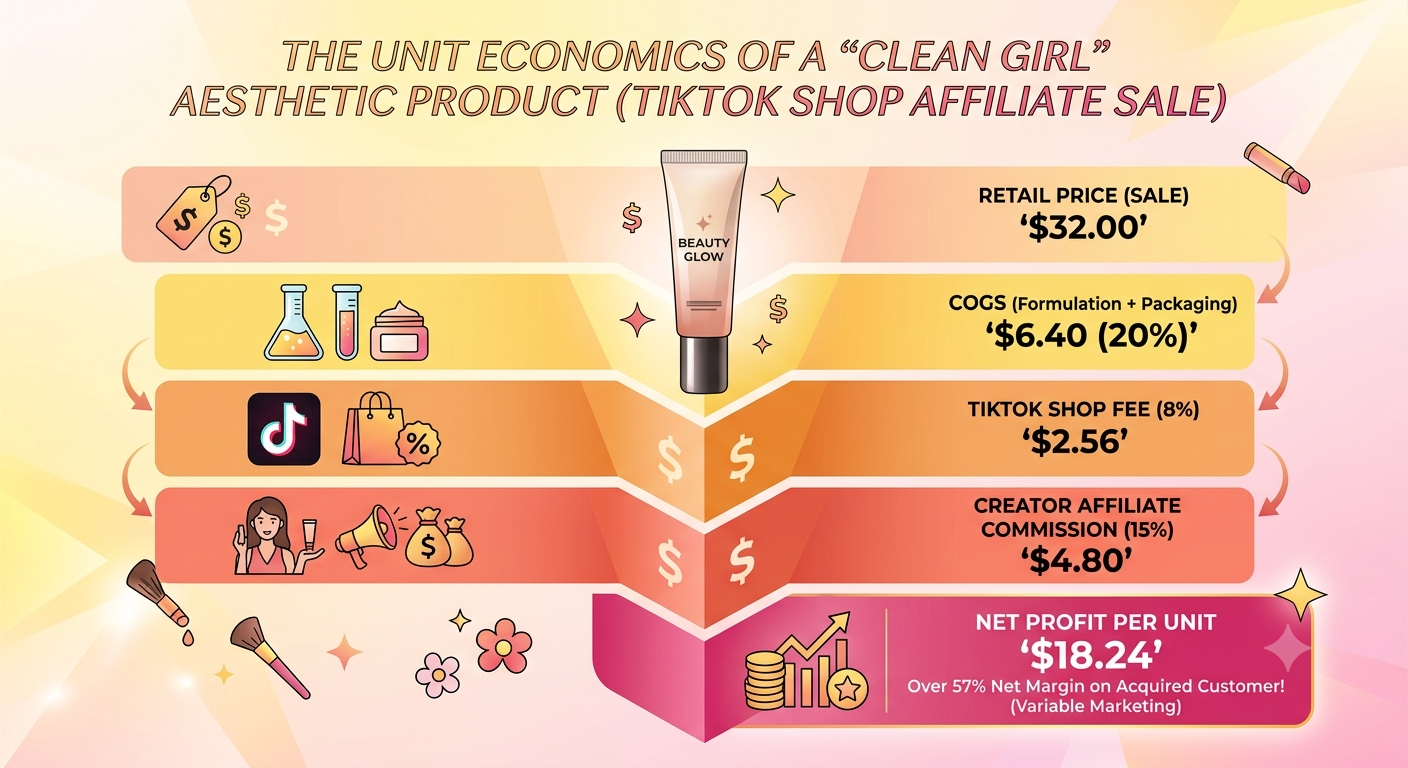
Let's look at a hypothetical mathematical model of a $32 clean beauty skin tint sold via a TikTok Shop affiliate link:
Retail Price = $32.00
COGS (Formulation + Packaging) = $6.40 (20%)
TikTok Shop Fee (8%) = $2.56
Creator Affiliate Commission (15%) = $4.80
Net Profit per Unit (Affiliate Sale) = $18.24
In this structure, the brand nets a 57% profit margin on a fully acquired customer without spending a single dollar on upfront advertising. The marketing expense is shifted entirely to a variable cost—meaning the brand only pays when a sale is locked in.
(If you’re a visual person like me, I’ve created a visual breakdown generated using Gemini AI; ready for you to download below)
The Bottom Line
This strategy would be most advantageous for independent beauty brand—especially those scaling out of Los Angeles as this ecosystem is a dream framework. The local infrastructure allows for agile product formulation, while social commerce channels like TikTok Shop provide a highly liquid, high-converting sandbox to test and scale products without burning venture capital on legacy ad structures.
The "Clean Girl" aesthetic isn’t just a visual trend of slicked-back buns and glowing skin. It is a masterclass in modern unit economics: low-cost formulation meeting low-friction social checkout. As I build my career at the intersection of business strategy and beauty in Southern California, analyzing these exact structural shifts is what reminds me that beauty is, fundamentally, an infrastructure game.

Takeaway
Leveraging TikTok as an ecommerce platform can lead to lower Customer Acquisition Costs.
It also boosts brand marketing while providing seamless in-app checkout, ensuring customers actually convert!
References
AutoFaceless.ai. (2026, April 9). TikTok Shop statistics 2026: GMV, seller data & social commerce growth. AutoFaceless Blog. https://autofaceless.ai/blog/tiktok-shop-statistics
Branvas. (2026, April 27). 50+ TikTok Shop statistics 2026: GMV, sellers & more. Branvas Insights. https://branvas.com/blogs/news/tiktok-shop-statistics
Darkroom. (2026). TikTok Shop fees 2026: Complete seller cost breakdown. Darkroom Observatory. https://www.darkroomagency.com/observatory/tiktok-shop-fees-seller-cost-breakdown-2026
Syncly. (2026, March 24). TikTok influencer marketing for beauty brands: A 2026 playbook. Syncly Blog. https://syncly.app/blog/tiktok-influencer-marketing-beauty-brands
