
What "Digital Transformation" Actually Means in 2026
Jessie Kim · Published June 2, 2026 · 9 min read
There is no phrase in business more overused, more misunderstood, and more expensive to get wrong than "digital transformation." It has appeared in every board deck, every consulting proposal, and every CEO letter to shareholders for the better part of a decade. And yet, after trillions of dollars spent, the failure rate remains stubbornly, embarrassingly high.
So let's be direct about what's actually going on — and what the companies getting it right are actually doing differently.
The Uncomfortable Numbers
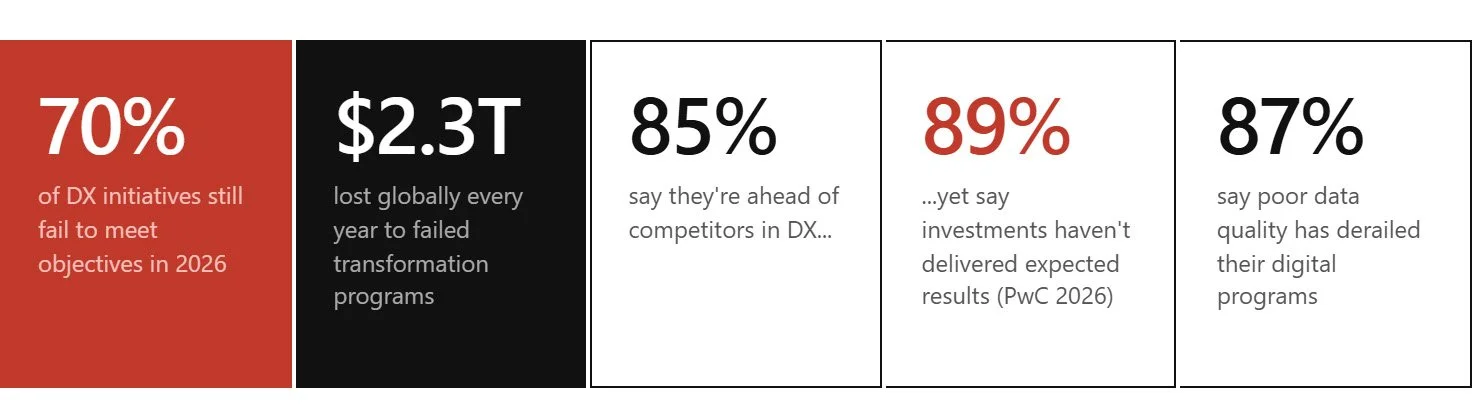
The stat cards above are not a quirk of one bad year. They represent a persistent, structural problem. In 2026, 70% of digital transformation initiatives still fail to meet their objectives, and globally these failed efforts cost organizations an estimated $2.3 trillion per year. Snowflake
The most revealing number, however, comes from PwC's 2026 Digital Trends in Operations Survey. Of 767 US operations and supply chain leaders surveyed, 85% say they are ahead of most competitors in digital transformation — yet 89% say their tech investments haven't fully delivered expected results. Read that again. Nearly everyone thinks they're winning. Almost no one is. BankInfoSecurity
The data foundation problem is nearly universal: 87% of operations leaders say poor data quality has hampered their ability to achieve value from digital initiatives. And only 27% have fully embedded an AI strategy across all business units. BankInfoSecurity
This is the central paradox of digital transformation in 2026: high confidence, low delivery.
The Old Definition Is the Problem
For years, "digital transformation" was treated as a synonym for technology procurement. Buy a new ERP. Migrate to the cloud. Launch an app. Check the box.
The myth vs. reality table above captures the shift in thinking that separates companies seeing real returns from those still chasing them. The core reframe: digital transformation is not a technology initiative — it is an operating model change that technology enables.
Most digital transformation projects fail due to human factors — resistance to change, poor software adoption, and execution gaps — not because the technology itself doesn't work. You can deploy the most sophisticated AI platform in the world and still fail if the people who are supposed to use it don't trust it, don't understand it, or were never brought along in the process. Snowflake
Research from BCG confirms that 70% of digital transformations fail due to a lack of employee engagement and resistance during implementation. Not bad software. Not the wrong vendor. People. Deloitte
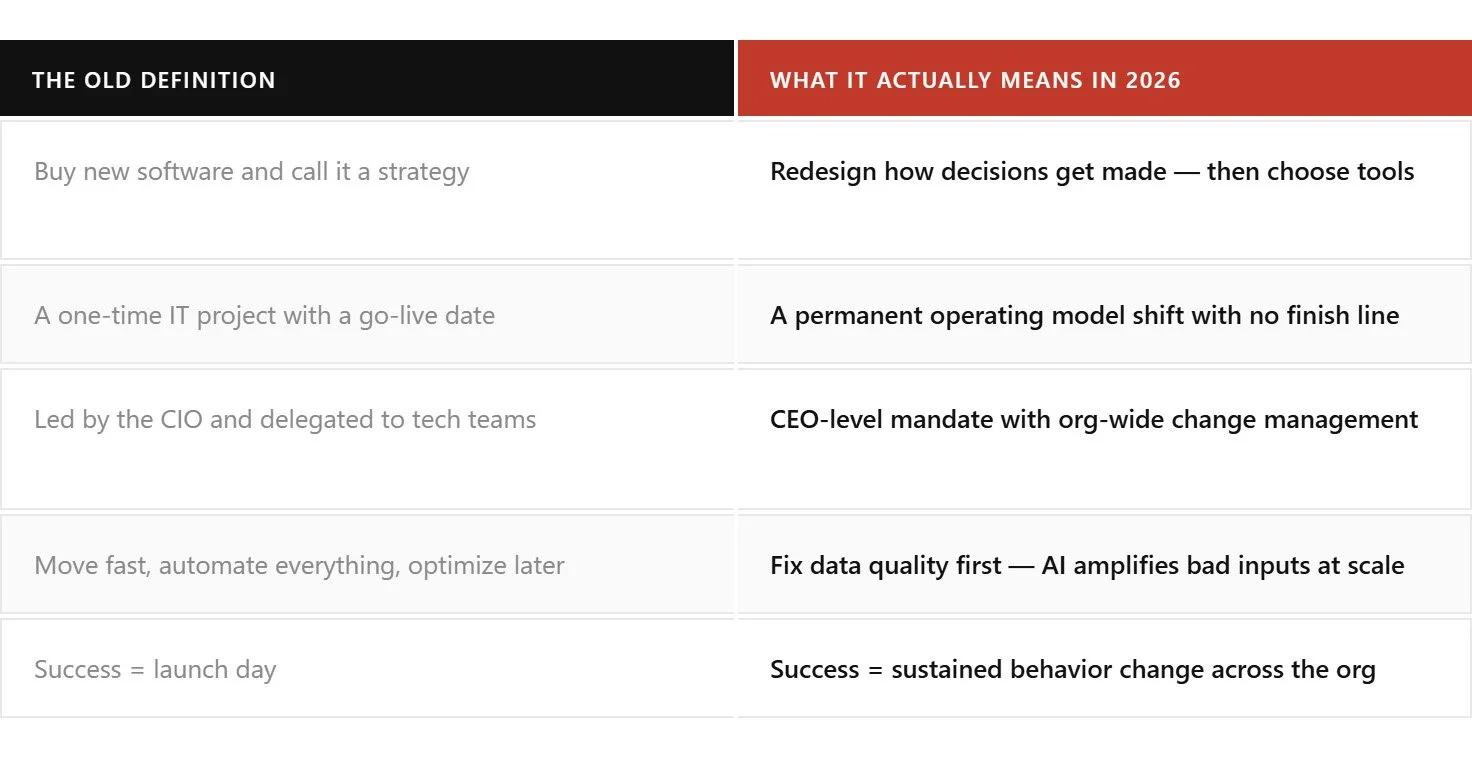
Definitions: What "digital transformation" actually means — myth vs. reality
What the Winners Actually Did
The company case studies above span retail, food, furniture, logistics, automotive, and entertainment — deliberately. Because the lesson isn't industry-specific.
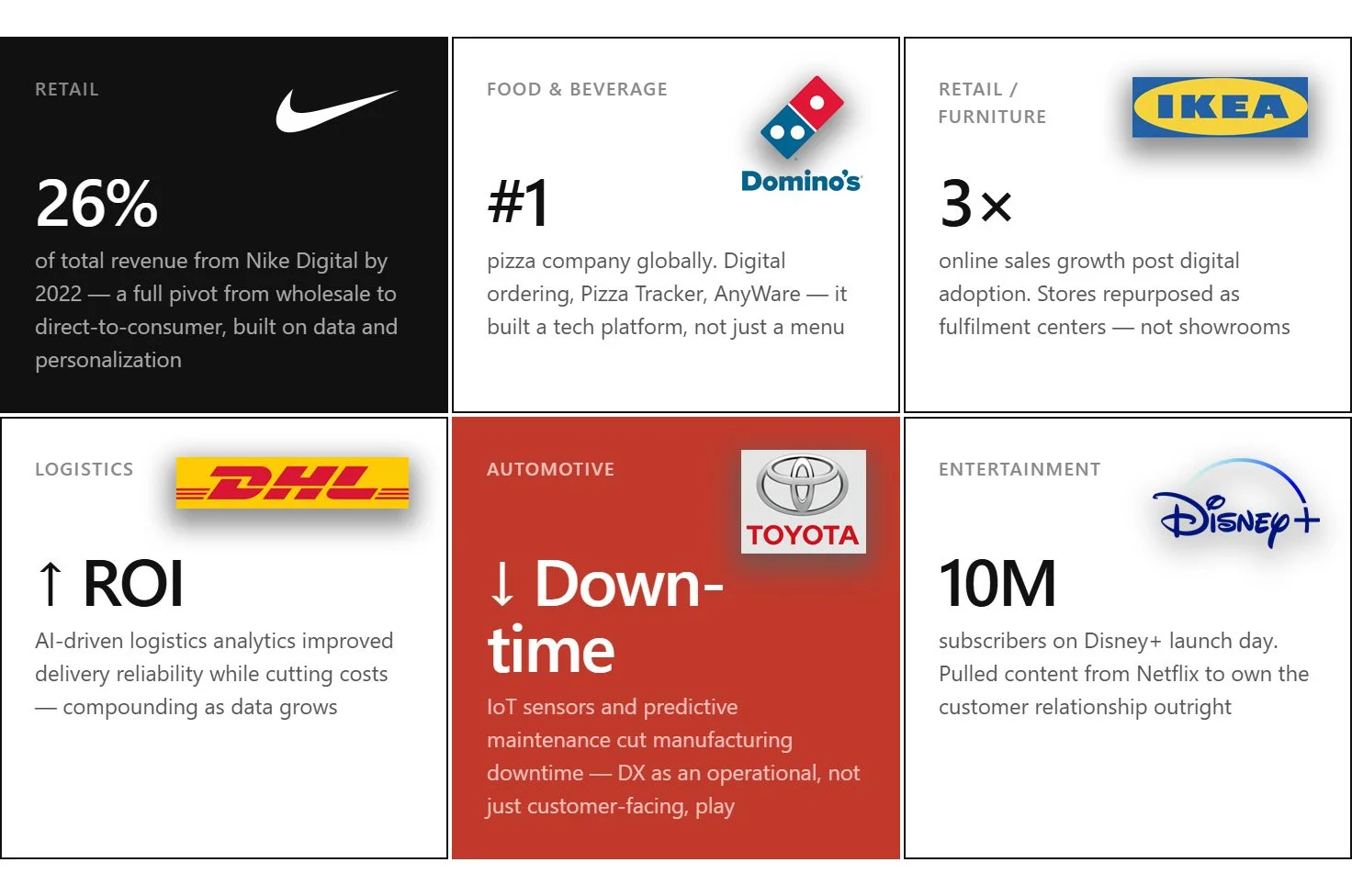
Description: Who got it right—and what they actually did
Nike didn't just build a better website. The company made a fundamental shift from wholesale accounts to direct-to-consumer digital sales, with Nike Digital accounting for 26% of total revenue by 2022 — a number that continues to grow. That required renegotiating retailer relationships, restructuring supply chains, and rebuilding how the company thought about its customer relationship entirely. sec
Domino's is perhaps the most cited case study in digital transformation for a reason. Since 2007 it has allowed customers to order pizzas online, and has since built features including Pizza Tracker, Pizza Builder, dedicated ordering apps, and AnyWare technology that lets customers order by text or Amazon Alexa. The result: a pizza company that operates more like a tech platform and has consistently outperformed far larger quick-service rivals. sec
IKEA made a subtler but equally significant move. After prioritizing digital strategy, IKEA tripled online sales, with brick-and-mortar stores evolving to function more like fulfillment centers than traditional retail outlets. The physical footprint didn't disappear — it was repurposed. Substack
DHL and Toyota demonstrate that transformation isn't only customer-facing. DHL's investment in AI-driven logistics analytics improved delivery reliability while cutting operational costs, and Toyota's use of IoT sensors and predictive maintenance reduced manufacturing downtime — with both systems becoming more valuable as they accumulate more data over time. C5 Insight
Disney executed one of the cleanest strategic pivots of the decade: pulling its content from Netflix to launch Disney+. Disney+ reached 10 million subscribers on its launch day — by owning the distribution relationship directly, Disney fundamentally changed its economics and its leverage in the content market. Investing.com
What ties these together is not a common technology stack. It's a common posture: transformation was treated as a business strategy decision first, and a technology implementation second.
The 5 Pillars That Actually Drive Results
The diagram above synthesizes what McKinsey, PwC, and BCG research consistently point to as the differentiators between transformation programs that deliver and those that don't.
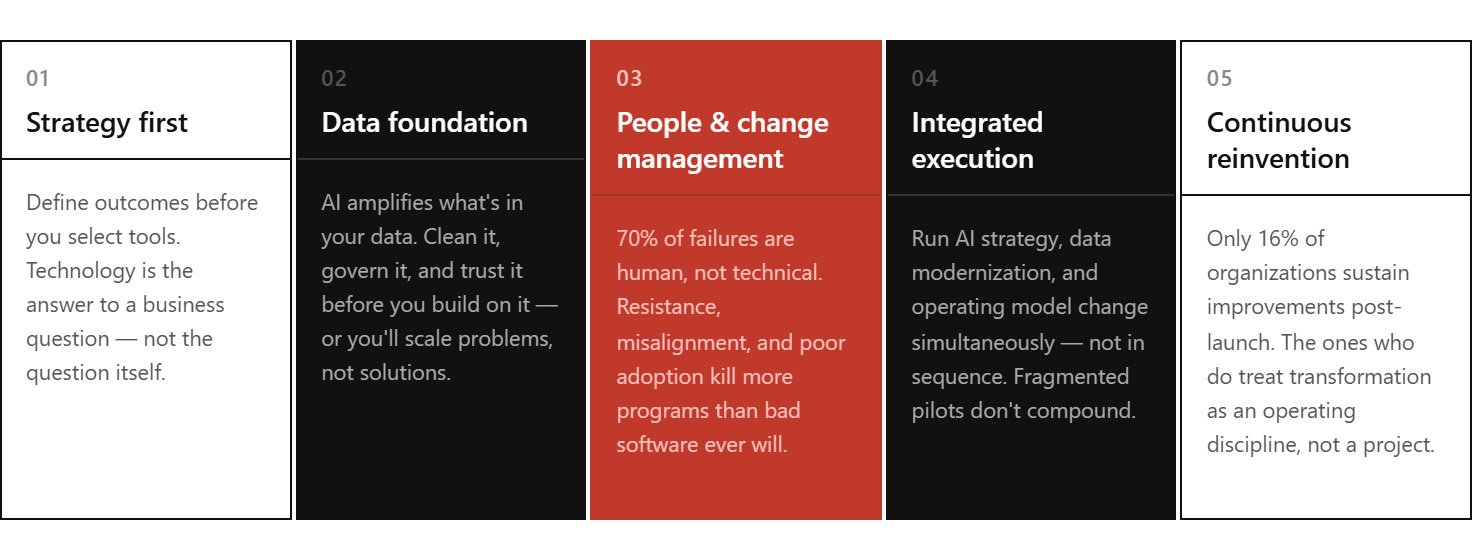
Source: McKinsey, PwC, BCG synthesis - buildwithjessie.com
1. Strategy First. The key to transformation success lies in strong leadership, clear objectives, and the right technology adoption — in that order. Tool selection is downstream of outcome definition, not the other way around. Fullview
2. Data Foundation. AI is an amplifier. It amplifies what's in your data — which means if your data has gaps, inconsistencies, or legacy structure problems, your AI outputs will reflect all of that at scale. Fix the foundation before you build on it.
3. People & Change Management. This is where most programs die. The problem isn't the digital technology — it's the human factors: uncertainty, disconnect, and misalignment — that cause transformation to stall. Robust change management is not a soft add-on; it's load-bearing infrastructure. sec
4. Integrated Execution. Competitive advantage won't come from isolated pilots or incremental upgrades, but by moving from fragmented progress to bold, integrated reinvention — running AI strategy, data modernization, and operating model change simultaneously, not in sequence. BigGo Finance
5. Continuous Reinvention. Only 16% of organizations report sustained performance improvements after a digital transformation initiative. The ones who do treat transformation as an ongoing operating discipline, not a project with a go-live date. Menlo Ventures
What This Means If You're Leading One
The PwC CEO Survey from January 2026 offered a sobering observation: only one in four CEOs say their organization has disciplined processes to stop underperforming initiatives, and CEOs report spending 47% of their time focused on issues with a horizon of less than one year, compared to just 16% on decisions looking more than five years ahead. Pfizer
Digital transformation lives in that five-year horizon. It requires a CEO-level mandate, sustained investment in people alongside technology, and the organizational discipline to kill programs that aren't working before they consume more budget.
The companies winning in 2026 are not necessarily the ones with the largest transformation budgets. Organizations with strong integration practices achieve a 10.3× higher ROI compared to 3.7× for those with weak integration. The difference isn't how much you spend. It's how coherently you execute. Menlo Ventures
Digital transformation in 2026 means exactly what it has always meant at its core — changing how your organization creates value. The technology is just the instrument. The strategy, the people, and the will to see it through are the thing.
References
BCG. (2020). Why digital transformations fail. Boston Consulting Group. https://www.bcg.com/publications/2020/increasing-odds-of-success-in-digital-transformation
CFlow. (2026, April 30). 40+ digital transformation statistics you need to know in 2026.https://www.cflowapps.com/digital-transformation-statistics/
Dreamix. (2026, April 17). 20 companies with successful digital transformation in 2026.https://dreamix.eu/insights/companies-with-successful-digital-transformation/
Gitnux. (2026). Digital transformation failure: 2026 verified stats & trends.https://gitnux.org/digital-transformation-failure-statistics/
Latenode. (2026). 10 digital transformation trends that actually matter in 2026.https://latenode.com/blog/digital-transformation-trends
Market.us. (2026, April 13). Digital transformation statistics and facts.https://market.us/statistics/information-and-communication/digital-transformation/
McKinsey & Company. (2021). Losing from day one: Why even successful transformations fall short. McKinsey Global Institute.
MeltingSpot. (2026, March 6). Why 70% of digital transformation projects still fail in 2026.https://blog.meltingspot.io/why-digital-transformation-projects-fail/
Prosci. (2025, May 23; updated April 13, 2026). 7 digital transformation examples that drove success.https://www.prosci.com/blog/digital-transformation-examples
PwC. (2026, January). 29th global CEO survey. PricewaterhouseCoopers. https://www.pwc.com/gx/en/news-room/press-releases/2026/pwc-2026-global-ceo-survey.html
PwC. (2026, April). 2026 digital trends in operations: How AI reinvents enterprise performance. PricewaterhouseCoopers. https://www.pwc.com/us/en/services/consulting/supply-chain-operations/library/digital-trends-operations-survey.html
WalkMe. (2026, April 17). 39 digital transformation statistics for 2026.https://www.walkme.com/blog/digital-transformation-statistics/
Whatfix. (2026, January 12). 21 examples of digital transformation case studies.https://whatfix.com/blog/digital-transformation-examples/
